Smart home technology has quickly become one of the most influential categories in multifamily proptech.
From smart locks and connected thermostats to IoT sensors, mobile credentials, and automated access control systems, operators are increasingly investing in technology designed to improve resident experience, operational efficiency, and long-term asset performance.
But as smart home ecosystems continue expanding, multifamily operators are facing a new challenge:
How do you build a technology ecosystem that remains flexible as the industry evolves?
That question is driving more conversations around agnostic smart home technology.
And for many multifamily organizations, the answer could determine how scalable, adaptable, and future-proof their technology strategy becomes over time.
What Is Agnostic Smart Home Technology?
Agnostic smart home technology refers to hardware and systems designed to work across multiple platforms, integrations, and vendors rather than locking operators into a single proprietary ecosystem.
In other words, operators maintain greater flexibility in how technologies connect, evolve, and scale across their portfolio.
This approach allows multifamily teams to integrate new technologies more easily, adapt as operational needs change, reduce dependency on a single vendor, and future-proof their technology ecosystem over time.
As smart property technology evolves rapidly, that flexibility is becoming increasingly valuable.
Why Proprietary Ecosystems Create Operational Risk
Many smart home solutions are designed as closed ecosystems.
While that can simplify implementation initially, it can also create long-term limitations around integrations, scalability, vendor flexibility, upgrade paths, and operational adaptability. Over time, operators may face challenges such as:
- expensive hardware replacements,
- fragmented resident experiences,
- disconnected data systems,
- limited interoperability,
- and difficulty introducing new technologies into the existing stack.
As portfolios grow and resident expectations evolve, these limitations can create operational friction that impacts long-term efficiency and scalability.
Why Flexibility Matters in Multifamily Technology
The multifamily industry changes quickly.
Resident expectations evolve.
Technology standards shift.
Operational priorities change.
New vendors enter the market constantly.
Because of this, operators increasingly need technology ecosystems that can adapt without requiring a complete infrastructure reset every few years.
Agnostic technology creates flexibility by allowing operators to scale across multiple communities, integrate with evolving platforms, avoid unnecessary hardware lock-in, and maintain stronger control over long-term technology strategy.
This is especially important as smart home technology becomes more connected to broader operational systems like:
- Property Management Systems (PMS),
- resident engagement platforms,
- access control systems,
- maintenance workflows,
- and portfolio-wide analytics.
The Resident Experience Also Depends on Integration
Smart home technology is not only an operational decision.
It is also a resident experience decision.
Residents increasingly expect seamless, connected experiences across access control, package delivery, guest entry, climate control, mobile credentials, and community amenities.
When systems fail to integrate smoothly, the resident experience becomes fragmented.
That creates app fatigue, usability frustration, inconsistent experiences, and lower long-term adoption.
Operators are beginning to realize that the best smart home experiences are often built around simplicity, interoperability, and operational cohesion rather than simply adding more disconnected features.
Why Evaluating Smart Home Technology Is Becoming More Complex
As smart home ecosystems grow, evaluating technology has become far more complicated than comparing hardware specifications or pricing models.
Operators now need to understand long-term scalability, integration compatibility, operational impact, workflow alignment, resident adoption, and market-specific performance expectations.
That complexity is one reason why many multifamily organizations struggle with expensive pilot cycles and fragmented technology decisions.
Because what works in one community may not perform the same way in another.
How Impact Analysis Reports Support Smarter Smart Home Decisions
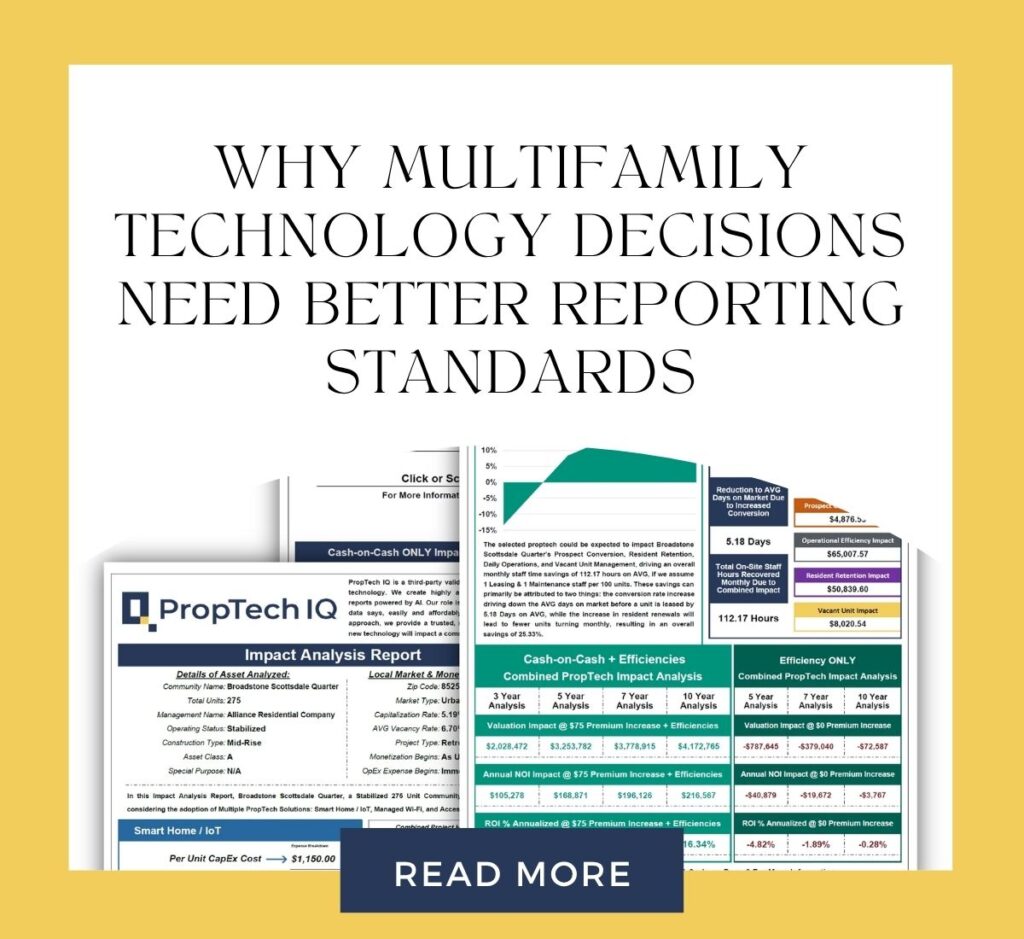
At PropTech IQ, our Impact Analysis Reports help multifamily owners, operators, and vendors evaluate smart home technology through independent, data-backed analysis tied to real operational conditions and market performance.
Our reports help organizations better understand how smart home technologies may affect:
- NOI,
- resident experience,
- operational efficiency,
- occupancy trends,
- scalability,
- and long-term portfolio performance.
Instead of relying solely on vendor claims or generalized benchmarks, operators gain clearer visibility into how technology may perform across their actual portfolio environment.
This helps organizations reduce uncertainty during evaluations, improve stakeholder alignment, avoid unnecessary pilot costs, and build smarter long-term technology ecosystems.
Because successful smart home adoption requires more than connected devices.
It requires connected strategy.
The Future of Multifamily Smart Home Technology
The future of smart home technology in multifamily will not be defined solely by how many devices a property installs.
It will be defined by interoperability, operational flexibility, resident experience, scalability, and measurable long-term value.
Operators who prioritize adaptable, agnostic technology ecosystems today will likely be better positioned to evolve alongside future technology innovations tomorrow.
Because in multifamily, flexibility is becoming one of the most valuable features a technology ecosystem can offer.
Ready to Evaluate Smart Home Technology More Strategically?
PropTech IQ helps multifamily organizations evaluate smart home technologies through independent Impact Analysis Reports powered by real market performance data and operational insights.
Whether you are evaluating access control systems, IoT platforms, smart locks, connected devices, or broader resident technology ecosystems, our reports help support smarter, more confident technology decisions.
Contact PropTech IQ today to learn how Impact Analysis Reports can help future-proof your smart home technology strategy.
PropTech IQ is an independent advisory firm and research partner to RETTC, the technology affiliate of NMHC. The firm does not sell technology or take vendor commissions. Learn more at proptechiq.com.