Every proptech vendor has a number.
“Save 20% on energy.”
“Reduce labor costs by 15%.”
“Improve occupancy by 5%.”
“Generate a 300% ROI.”
The problem isn’t necessarily that these numbers are wrong.
The problem is that they may not be relevant to your property.
Multifamily technology performance is highly dependent on market conditions, property characteristics, operating costs, staffing models, resident behavior, and how a solution is actually implemented. A result that looks impressive in one community may look very different in another.
That is why evaluating proptech requires more than accepting a vendor’s ROI calculation at face value.
Why Vendor ROI Claims Need Context
Vendor-provided ROI estimates are often designed to communicate the potential value of a solution quickly. They can be useful for understanding the business case, but they rarely tell the entire story.
Consider a smart thermostat.
A vendor may estimate a certain percentage reduction in energy consumption. But the actual financial impact depends on factors such as:
- Local energy costs
- Climate and weather patterns
- Property construction
- Unit occupancy and vacancy
- Existing HVAC systems
- Resident behavior
- Installation costs
- Ongoing software fees
The same technology can therefore produce very different financial outcomes across different markets.
A percentage alone doesn’t tell you what the investment is worth.
Context does.
The Same Technology Can Perform Differently in Different Markets
Multifamily properties aren’t interchangeable.
A technology deployed at a Class A high-rise in a major coastal market operates within a very different environment than the same technology deployed at a suburban garden-style community in the Midwest.
Labor costs can vary.
Energy costs can vary.
Rent levels can vary.
Vacancy rates can vary.
Resident expectations can vary.
Even the operational workflows surrounding a technology can vary.
This is why generic benchmarks can be useful for establishing a starting point—but insufficient for making a final investment decision.
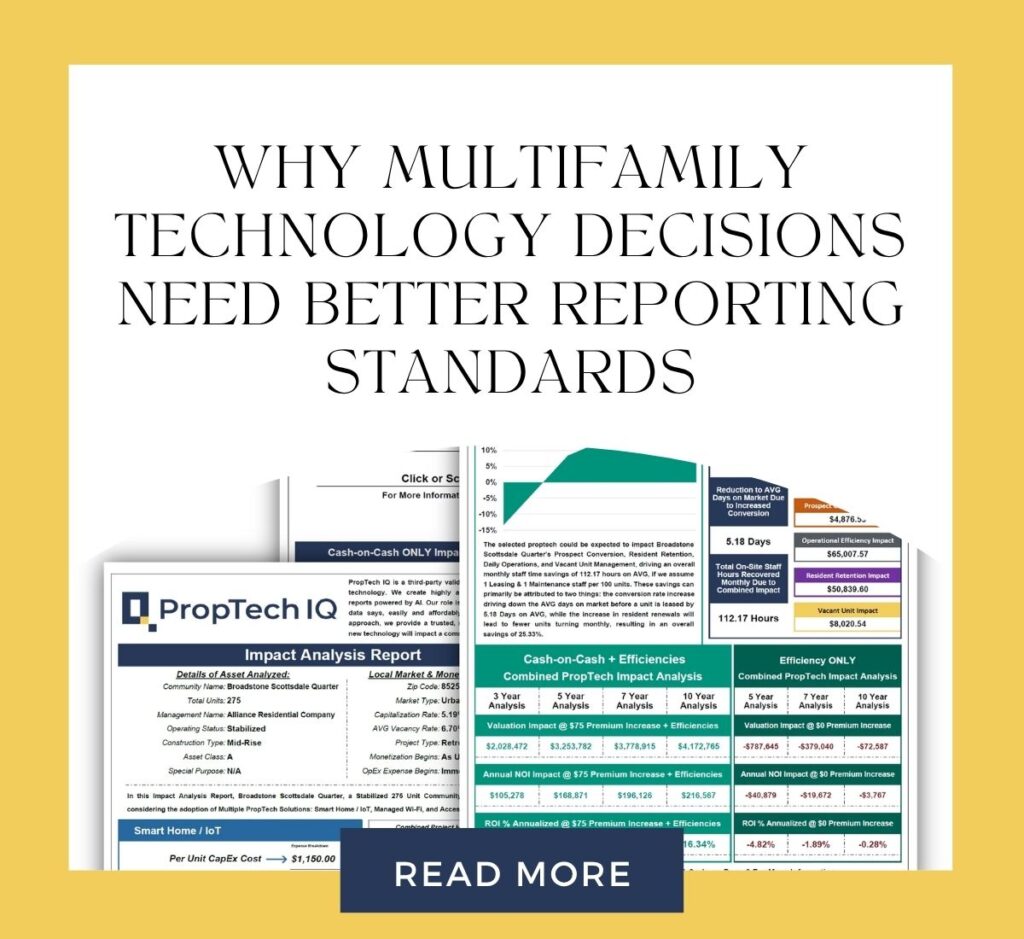
PropTech IQ’s approach is designed around this reality. Impact Analysis Reports incorporate property-specific information alongside market data, industry benchmarks, and historical implementation data to produce a more localized view of potential technology impact.
ROI Is More Than a Single Number
Another problem with generic ROI claims is that they can oversimplify how technology creates value.
A technology may affect multiple areas of a property simultaneously.
For example, self-touring technology could influence:
- Leasing team productivity
- Number of tours completed
- Time to lease
- Days a unit remains vacant
- Staffing efficiency
- Revenue generated from occupied units
Similarly, an IoT solution could affect energy consumption, maintenance workflows, resident experience, and operational efficiency.
Looking only at one benefit can miss the broader financial impact.
That is why a stronger technology evaluation considers both financial and operational outcomes.
What Should Operators Ask Instead?
Instead of asking only: “What’s the ROI?” Operators should ask: “What is the projected impact of this technology on my specific property?”
Then dig deeper.
- What data supports the projection? Is the estimate based on generic assumptions, historical implementation data, market data, or actual property-specific inputs?
- Does the analysis reflect my market? Energy, labor, rent, vacancy, and operating costs can vary significantly from one market to another.
- What are the implementation costs? Hardware, installation, integration, training, software subscriptions, and ongoing maintenance can all affect the economics of a technology investment.
- What operational efficiencies are included? Technology can create value by reducing manual work, improving staff productivity, accelerating leasing, or reducing maintenance demands—not just by generating new revenue.
- What happens after implementation? A strong evaluation should consider the longer-term financial and operational implications rather than focusing only on the initial deployment.
Why Independent Validation Matters
This is where independent third-party analysis becomes particularly valuable.
A vendor has an obvious incentive to communicate the value of its product. That doesn’t make vendor-provided data inherently unreliable, but it does mean buyers should have a way to validate the assumptions behind the claims.
PropTech IQ provides independent Impact Analysis Reports specifically for this purpose.
The reports combine property-specific information with market data, industry benchmarks, and historical implementation data to evaluate the potential impact of a technology on a specific community. The analysis can evaluate factors including:
- NOI
- ROI
- IRR
- Capital expenditures
- Operating expenditures
- Efficiency gains
- Vacancy impact
- Resident retention
- Market conditions
This creates a more complete picture than relying on a single vendor-provided ROI percentage.
Impact Reports Help Move the Conversation From Claims to Evidence
The goal isn’t to prove that every vendor’s projections are wrong.
It’s to determine whether the technology makes sense for the property being evaluated.
That distinction matters.
An Impact Analysis Report gives owners and operators an independent data point they can use alongside the vendor’s proposal, helping stakeholders compare solutions, evaluate assumptions, and understand potential outcomes before committing to an investment.
It can also reduce the need to rely exclusively on costly and time-consuming pilot programs. PropTech IQ states that its reports are designed to provide property-specific projections without requiring a pilot.
For vendors, independent validation can also strengthen the sales conversation. Instead of asking a prospect to simply trust a claim, vendors can provide a third-party analysis showing how their technology could perform under the prospect’s specific conditions.
Better PropTech Decisions Require Better Questions
The multifamily industry doesn’t need fewer technology vendors.
It needs better ways to evaluate them.
A generic ROI claim can tell you what a technology might accomplish.
A property-specific, data-backed analysis can help you understand what that impact could look like where you actually operate.
That’s the difference between asking: “Does this technology have a good ROI?” and asking: “Does this technology make financial and operational sense for us?”
The second question leads to better decisions.
Make Your Next PropTech Decision With More Confidence
PropTech IQ’s Impact Analysis Reports provide independent, data-backed analysis to help multifamily owners, operators, developers, and technology vendors better understand the potential financial and operational impact of proptech.
Reports are built using property-specific inputs, market data, industry benchmarks, and historical implementation data to provide a more relevant view of technology performance.
Contact PropTech IQ today to learn how an Impact Analysis Report can help you validate ROI and NOI claims, reduce uncertainty, and make your next technology decision with greater confidence.