Smart technology is often marketed as a way to improve the resident experience.
But for multifamily owners, developers, and managers, the bigger opportunity may be what happens behind the scenes.
The right technology can help reduce operating costs, make onsite teams more productive, decrease vacancy-related expenses, and ultimately improve Net Operating Income (NOI).
The key is knowing which technologies actually create measurable value for your property.
Smart Technology Can Reduce More Than One Cost
Multifamily operating expenses come from many places: staffing, utilities, maintenance, vacancy, administrative work, and more.
Smart technology can potentially address several of these areas at once. For example:
- Self-touring can help leasing teams handle more prospects.
- IoT can help reduce unnecessary energy consumption.
- Automation can eliminate repetitive administrative work.
- Smart access control can reduce manual processes.
- Predictive and preventive technologies can help teams address issues earlier.
But the financial impact isn’t the same for every property.
A technology that creates significant savings in one market may have a smaller impact somewhere else because labor costs, energy prices, vacancy rates, property characteristics, and existing infrastructure are different.
That’s why property-specific analysis matters.
Self-Touring Can Turn Leasing Technology Into a Force Multiplier
Consider self-touring.
Without self-touring, leasing staff may spend a significant portion of their day physically showing units to prospects. That limits how many prospects they can engage with and restricts tours to the hours when staff are available.
Self-tour technology changes that equation.
Prospects can tour on their own schedule, including outside traditional leasing office hours. At the same time, leasing professionals can spend more of their time on conversations, follow-ups, applications, and other activities that require a human touch.
The goal isn’t to replace the leasing team.
It’s to make the team more productive.
More accessible tours can create more opportunities for conversion, potentially reducing the time a unit sits vacant.
And every day a vacant unit becomes occupied sooner can have a direct impact on property revenue.
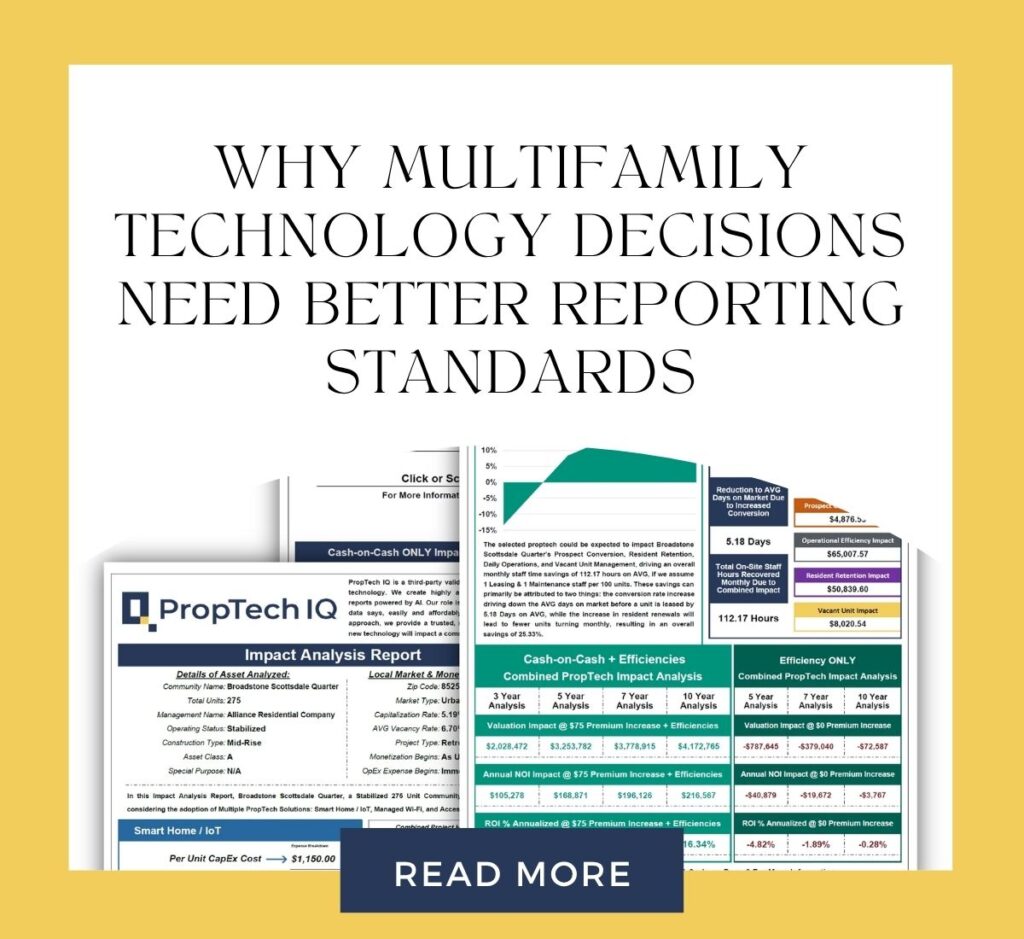
PropTech IQ’s Impact Analysis Reports specifically account for efficiency areas such as prospect conversion, operational efficiency, resident retention, and vacant-unit impact when evaluating potential technology performance.
Staffing Efficiency Is About More Than Reducing Headcount
One common misconception is that technology creates value only when it reduces staffing.
That’s not necessarily the goal.
In today’s multifamily environment, technology can be a force multiplier for existing teams.
If a platform eliminates repetitive data entry, automates resident onboarding, or handles routine tasks, employees can redirect their time toward higher-value work.
For example, when a resident is moved into the Property Management System, integrations can potentially trigger actions across connected platforms—such as creating access credentials or updating smart building systems.
One action can replace several manual steps.
That matters when teams are already stretched thin.
The better question isn’t: “How many employees can this technology replace?” It’s: “How much more can our existing team accomplish with this technology?”
Vacant Units Create a Hidden Operating Expense
Vacancy isn’t only a lost rent opportunity.
A vacant apartment can also continue generating costs.
One example is electricity.
When a unit is vacant, owners may still be responsible for keeping the space conditioned and maintaining basic utilities. Smart thermostats and other IoT technologies can potentially reduce unnecessary energy consumption during these periods.
The actual savings depend heavily on the market and property.
Energy prices, climate, HVAC systems, building characteristics, and vacancy patterns all influence the potential impact.
A generic claim such as “our technology reduces energy costs by 20%” doesn’t tell an owner how much that could mean for their specific community.
The percentage isn’t the business case. The dollar impact is.
Technology Can Improve NOI From Both Sides
NOI is affected by revenue and operating expenses. That means technology can potentially improve NOI in more than one way.
Increase revenue
Technology can contribute to:
- Faster leasing
- Higher prospect conversion
- Reduced days vacantImproved resident retention
- Potential ancillary revenue opportunities
Reduce expenses
Technology can potentially reduce:
- Labor requirements for repetitive tasks
- Energy consumption
- Administrative workload
- Maintenance costs
- Other operational expenses
PropTech IQ’s analysis methodology evaluates these types of efficiency impacts alongside financial measures such as NOI, ROI, and property valuation.
This broader view is important because a technology investment doesn’t have to create a new revenue stream to generate value.
Sometimes the opportunity is simply making the existing operation more efficient.
Why the Same Technology Won’t Deliver the Same ROI Everywhere
A smart thermostat, self-touring platform, access control system, or AI leasing solution can produce different results from property to property.
Consider two communities.
One may have:
- High labor costs
- High energy rates
- Significant vacancy
- Older infrastructure
Another may have:
- Lower labor costs
- Lower energy costs
- Low vacancy
- Recently upgraded systems
The same technology could have a dramatically different financial case for each property.
That’s why multifamily technology decisions shouldn’t rely solely on national averages or vendor-provided ROI claims.
PropTech IQ’s Impact Analysis Reports use property-specific information alongside market data, industry benchmarks, and historical implementation data to create a more relevant projection of technology impact.
What Should Owners and Operators Ask Before Investing?
Before approving a new technology, consider five questions:
- What operating expense is this actually addressing? Be specific. Is it labor, energy, maintenance, vacancy, or administrative work?
- How much work will it eliminate? A technology that adds another platform for staff to manage may not create the efficiency you’re expecting.
- What revenue impact could it create? Consider faster leasing, reduced vacancy, retention, or other measurable revenue opportunities.
- How does the economics change in my market? Local labor costs, energy prices, vacancy, and property characteristics matter.
- Can the expected impact be independently validated? Vendor claims are a starting point—not necessarily the final answer.
How Impact Analysis Reports Help
This is where PropTech IQ’s Impact Analysis Reports can add value.
An Impact Analysis Report is an independent, data-driven assessment of how a specific proptech solution is projected to affect a multifamily property’s financial performance and operational efficiency. The analysis considers factors including NOI, ROI, CapEx, OpEx, efficiency gains, and other property-specific considerations.
For owners, developers, and managers, the report can help answer: “Does this technology make financial sense for our property?”
For vendors, it provides an independent way to demonstrate potential value without relying exclusively on generic benchmarks or marketing claims.
PropTech IQ says its reports are free to multifamily owners, developers, and managers, with the vendor covering the cost.
That makes independent analysis easier to incorporate into the technology evaluation process.
Smart Technology Should Make the Property Smarter
The goal of smart technology isn’t simply to add more devices, platforms, or automation.
It’s to create a property that operates more efficiently.
A successful technology investment should help your team do more, reduce unnecessary expenses, improve the resident experience, or create measurable financial value.
And ideally, it should do several of those things at once.
But before investing, prove the potential impact.
Make Your Next Technology Investment a Smarter One
Whether you’re an owner evaluating a vendor, a developer planning a new community, a manager looking to improve operations, or a technology provider trying to prove your solution’s value, the conversation should ultimately come back to measurable outcomes.
PropTech IQ’s Impact Analysis Reports provide independent, data-backed insights into how technology can affect property performance, helping stakeholders evaluate investments with greater clarity and confidence.
Reach out to PropTech IQ today to request an Impact Analysis Report and discover what your next technology investment could actually do for your property.