The promise of automation is simple: technology should take work off your team’s plate.
Yet across multifamily operations, that isn’t always what happens.
A new platform gets implemented to streamline a process, but onsite teams still have to enter the same information into multiple systems. Another solution generates valuable data, but someone has to manually move that data somewhere else. A smart building platform automates one workflow while creating three new administrative tasks.
That’s not meaningful automation.
As multifamily operators invest in AI, IoT, access control, smart home technology, and other proptech solutions, the goal shouldn’t be to automate for automation’s sake.
The goal should be to remove work, connect systems, and give people more time to focus on what actually requires human attention.
What Does Proptech Automation Actually Mean?
Proptech automation uses connected technologies to complete repetitive tasks, move information between systems, and trigger actions with less manual intervention.
Consider a common multifamily workflow.
A leasing agent moves a new resident into the Property Management System (PMS). Without effective integrations, someone may then need to create that resident’s profile in an access control platform, assign smart home permissions, update another resident system, and potentially enter the same information elsewhere.
With the right automation in place, that initial action in the PMS can trigger the other steps automatically.
One action. Multiple systems updated. Less manual work.
That’s the type of efficiency operators should be looking for.
APIs Are the Foundation of Better Automation
For multifamily technologies to automate workflows effectively, they need a way to communicate.
That’s where APIs come in.
An Application Programming Interface, or API, allows different software systems to exchange information and trigger actions. For example, APIs can help connect:
- Property Management Systems
- Access control platforms
- IoT and smart home systems
- Maintenance software
- Leasing technology
- Resident-facing platforms
- Business intelligence tools
When these connections are built thoughtfully, data doesn’t have to stop inside the platform that generated it.
A maintenance system can share information with other operational systems. An access control platform can respond to resident status changes. Smart devices can provide information that supports proactive maintenance.
The result is an ecosystem where technology works together instead of requiring people to serve as the connection between platforms.
What Happens When Standard APIs Aren’t Available?
The multifamily technology ecosystem isn’t perfectly standardized.
IoT, access control, and other specialized platforms may use proprietary systems that can’t communicate easily through standardized APIs.
That doesn’t necessarily mean integration is impossible.
Secure middleware platforms can create a communication layer between otherwise disconnected systems, allowing information to move between them without requiring employees to manually bridge the gap.
The specific technology may differ, but the objective remains the same:
Your employees shouldn’t be doing work that your systems could be doing for them.
Automation Without Integration Can Create More Work
Adding automation to a fragmented technology ecosystem can actually make operations more complicated. Imagine introducing a new platform that successfully automates one task but requires employees to:
- Log into another system.
- Export a report.
- Reformat the data.
- Upload it somewhere else.
- Check whether everything synchronized correctly.
Technically, part of the workflow has been “automated.”
Operationally, you may not have gained much.
That’s why technology evaluations should look beyond individual features.
Operators need to understand how a solution fits into the entire technology ecosystem.
Ask questions like:
- What existing systems does it integrate with?
- What manual steps will it eliminate?
- Will it create any new workflows for onsite teams?
- How will data move between platforms?
- Who will need access to that data?
- What happens when something fails?
The answers can tell you far more about potential operational efficiency than a feature list alone.
Don’t Forget Security and Data Governance
Connecting systems also means moving data between them.
That makes security an essential part of any automation strategy.
Depending on the technology and data involved, operators may need to consider encryption, access permissions, authentication, data storage, and role-based access controls.
Not every employee needs access to every piece of information.
A well-designed technology ecosystem should give people access to the data they need to perform their jobs while appropriately restricting sensitive information.
Operators should also consider how frequently systems exchange data.
Not every platform needs information updated every few seconds. Excessive data transfers can create unnecessary infrastructure and cloud costs without delivering meaningful operational value.
The right cadence depends on the workflow.
The important thing is that connected systems operate on a schedule that supports the business without creating unnecessary complexity or expense.
AI Makes the Foundation Even More Important
AI is making automation significantly more powerful.
Teams can increasingly use AI to summarize information, identify patterns, organize knowledge, assist with decision-making, and complete tasks that once required hours of manual work.
But AI doesn’t eliminate the need for a strong technology foundation.
It makes that foundation even more important.
If your systems are disconnected, your data is inconsistent, or important information remains trapped inside individual platforms, it becomes harder to build effective AI-powered workflows on top of them.
Before asking, “How can we use AI?” It may be more useful to ask: “Is our technology ecosystem ready for AI?”
Standardized data, effective integrations, secure information sharing, and clearly defined workflows create a stronger foundation for whatever comes next.
The Real Measure of Automation Is Time Given Back
Operators shouldn’t measure automation solely by how many processes have been automated.
A better question is: What can our people do now that they couldn’t do before?
Maybe leasing agents spend less time entering information and more time speaking with prospects.
Maybe maintenance teams receive information earlier and can address problems proactively.
Maybe regional managers spend less time assembling reports and more time analyzing performance.
Maybe leadership can access insights without waiting days for someone to compile spreadsheets.
That’s when automation starts creating meaningful operational value.
Technology becomes a force multiplier for the people already running the business.
How Do You Know Whether Automation Is Actually Working?
Implementation is only the beginning.
Once automation is in place, operators need to measure what changed. Depending on the solution, that could mean evaluating:
- Staff hours saved
- Work order volume
- Maintenance response times
- Leasing conversion
- Days vacant
- Energy consumption
- Operational expenses
- Resident satisfaction
- NOI impact
This is where data becomes particularly valuable.
Instead of assuming that automation created efficiency because a process became digital, operators can evaluate whether it produced measurable improvements.
Measure the Impact, Not Just the Implementation
At PropTech IQ, we believe technology evaluation shouldn’t end when a platform goes live.
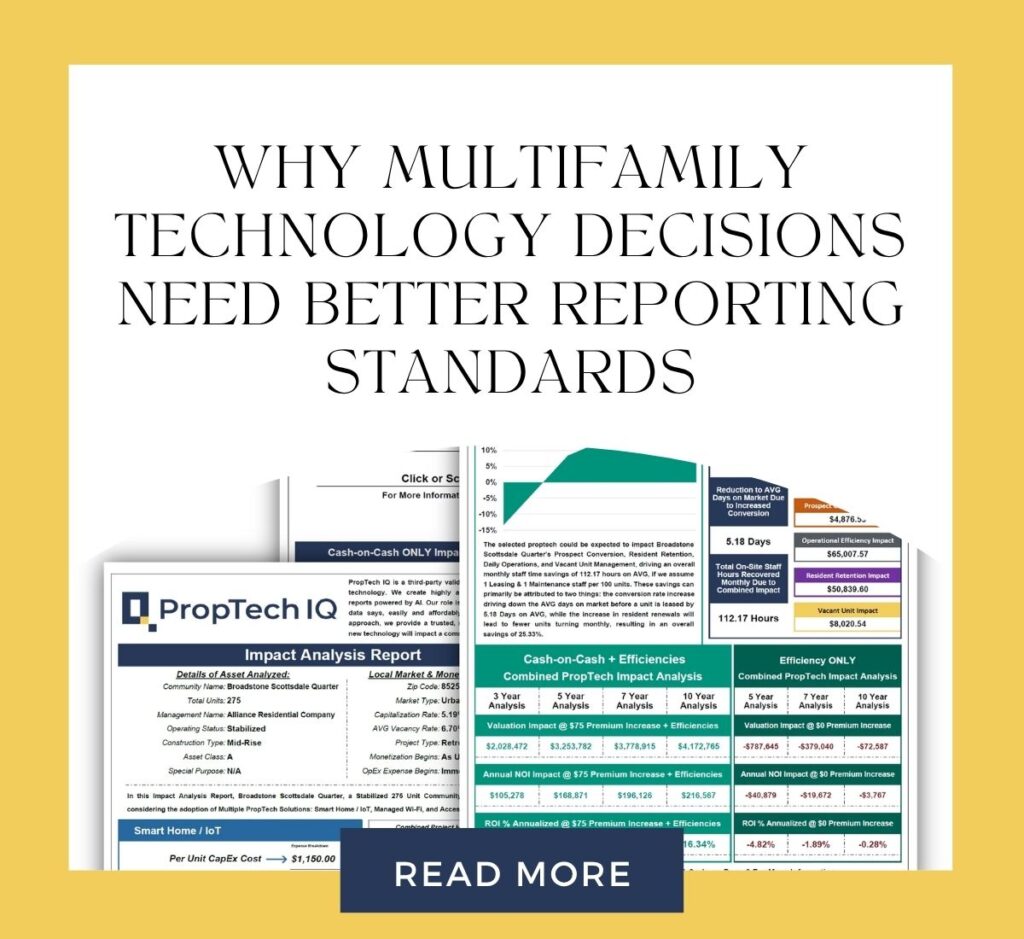
Our Impact Analysis Reports help multifamily organizations evaluate the operational and financial impact of technology using independent, data-backed analysis.
That means looking beyond what a solution promises to do and asking what measurable value it can create within a specific operating environment.
Because successful automation isn’t about having the most integrations, the most AI tools, or the most sophisticated technology stack.
It’s about building an ecosystem where technology handles the work it should so your people can focus on the work that matters.
Contact PropTech IQ today to learn how our Impact Analysis Reports can help you evaluate the measurable impact of your technology investments and build a smarter, more efficient multifamily technology strategy.