From choosing the right hardware to measuring market-specific ROI, making smarter in-unit technology decisions starts with understanding what works, what scales, and what supports long-term property performance.
In-unit technology has become an increasingly important part of multifamily operations. Smart locks, thermostats, access control, sensors, and connected platforms can influence everything from operational efficiency to resident experience. But adopting technology is not simply a matter of choosing the latest devices or signing with a popular vendor.
For owners and operators, the bigger questions are about compatibility, scalability, implementation, and measurable value. Will the hardware still work if a platform provider exits the market? Can a small pilot accurately demonstrate the impact of a technology investment? Does a solution deliver the same results across different markets?
These are some of the questions Taylor Wiederkehr, Founder and CEO of PropTech IQ, addressed during a panel discussion on in-unit technology.
Drawing on his experience leading innovation initiatives at Alliance Residential and BH Management, as well as PropTech IQ’s work evaluating multifamily technology, Taylor shared practical insights into how operators can make more informed decisions.
Here are eight important questions multifamily leaders should consider before investing in in-unit technology.
1. What Does Agnostic Hardware Mean for In-Unit Smart Home Technology?
Agnostic hardware is designed to work across multiple software platforms rather than being locked into a single provider’s ecosystem.
For multifamily owners, this flexibility can make a significant difference over the life of a property. Devices such as smart locks and thermostats built on open standards like Z-Wave can potentially continue operating even if an owner decides to change platform providers.
Why does this matter? Hardware manufacturers continuously introduce new products, but the software platform is what property teams interact with every day. Choosing hardware that supports flexibility gives owners more options as their technology needs evolve.
Taylor’s recommendation: Choose the platform partner first, then select the hardware that supports it. Starting with the platform helps ensure the technology aligns with the property’s operational requirements and long-term strategy.
2. What Happens If a Smart Home Platform Vendor Leaves Multifamily?
Vendor stability is an important consideration when investing in property technology. A platform provider may change its business direction, discontinue a product, or exit the multifamily market altogether.
Owners using agnostic hardware may have more flexibility in this situation. Instead of replacing every device, they may be able to introduce a new hub or platform while keeping their existing hardware.
Taylor shared an example from his experience at Alliance Residential and BH Management, where his teams deployed seven different vendors. One of those platform companies eventually exited multifamily. Because the hardware was Z-Wave-based, the team could transition to another provider’s hub, including solutions from companies such as PointCentral or SmartRent, without replacing all the devices.
Proprietary systems can offer advantages, but they may also create greater dependency on a single provider.
What operators should consider: Understand the trade-offs before committing to a proprietary ecosystem. Ask what functionality or advantages justify the decision, what happens if the vendor exits the market, and what it would take to transition to another platform.
3. Will a Small Pilot Show Whether Centralized Smart Home Technology Works?
A small pilot can help operators understand how a technology works, but it may not demonstrate the full operational value of a portfolio-wide investment.
According to Taylor, the benefits of centralized smart home technology become more apparent when implemented at scale. Changing a property’s foundational operating systems while maintaining a mix of platforms and devices can introduce additional complexity for onsite teams.
His experience managing multiple technology vendors over several years reinforced an important lesson: running too many systems simultaneously can undermine the very efficiencies the investment was intended to create.
This is why operators need to evaluate technology beyond the initial pilot.\
What operators should consider: Look at implementation data from communities where the technology is already operating at scale. Understand how it affects workflows, staffing requirements, integrations, and day-to-day property operations before deciding whether to expand.
At PropTech IQ, technology evaluations incorporate real implementation data from installed communities, helping owners assess potential value beyond what a limited pilot can demonstrate.
4. Does Smart Home Technology Perform the Same in Every Market?
No. A technology solution that delivers value in one market may produce different results in another.
Taylor explained that PropTech IQ’s implementation data reveals differences in the retention and conversion impact of smart home technology between markets such as Florida and Alabama. Energy costs can also create different investment considerations in Texas compared with California.
Local conditions matter. Utility expenses, resident expectations, property characteristics, and the competitive environment can all influence the potential value of an investment.
In some markets, solutions such as managed Wi-Fi or monitored security may make more financial and operational sense than implementing a full smart home automation package.
What operators should consider: Ask vendors for implementation experience in the specific markets where your properties operate. Find out which communities have deployed the technology, when the installations went live, and what residents are paying for the associated services.
A market-specific evaluation can help operators avoid relying on assumptions based on results from entirely different operating environments.
5. How Does PropTech IQ Validate Property Technology?
Technology claims and vendor projections are useful starting points, but operators need evidence that a solution can deliver value in real-world multifamily environments.
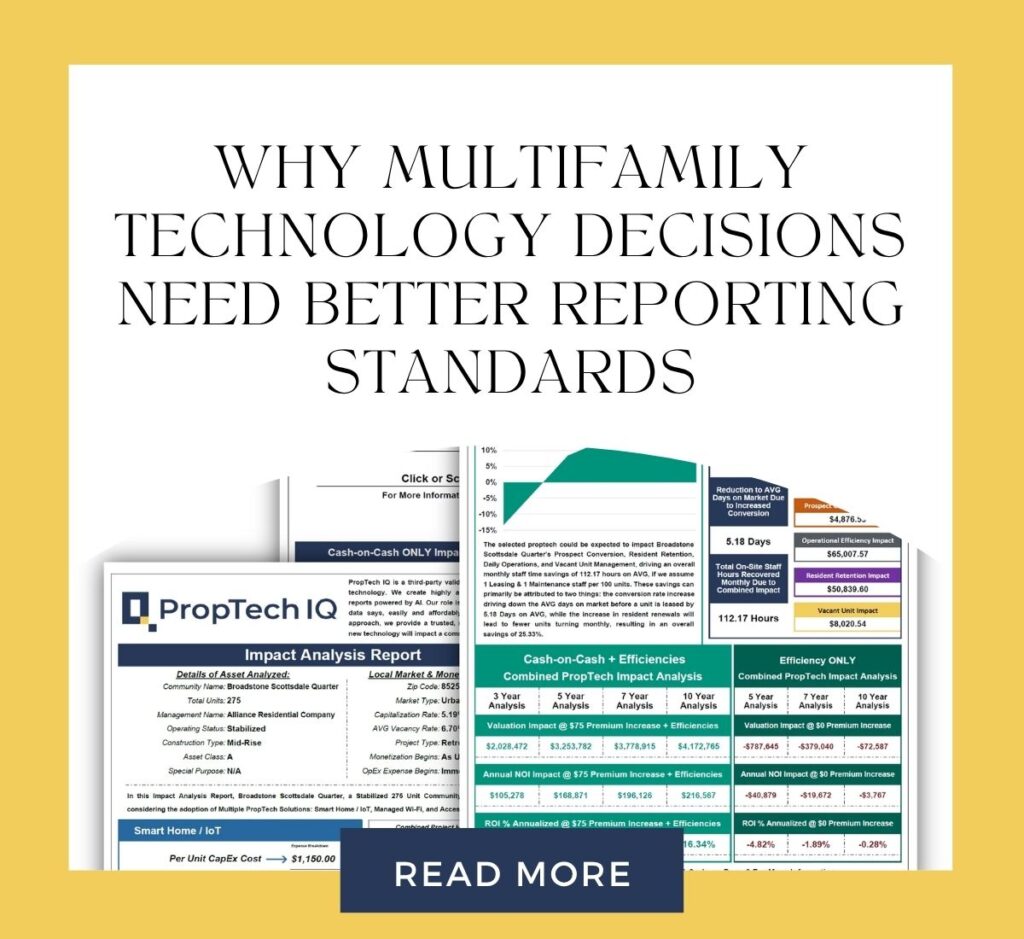
PropTech IQ approaches technology evaluation by examining actual implementation data. Through data shared by technology providers—including information about installation locations, deployment timelines, and installed solutions
PropTech IQ can assess how technologies are performing across different properties and markets.
The company combines this information with its own data partnerships and market analysis to evaluate potential value from an owner’s perspective.
That evaluation can include:
- Financial impact: Potential returns measured through cash-on-cash considerations and other financial indicators.
- Operational efficiency: Opportunities to improve workflows and reduce operational friction.
- Operating expenses: How a technology investment compares with the property’s existing underwritten expenses.
- Market performance: How results may differ depending on location and property characteristics.
Taylor founded PropTech IQ in 2020 after leading innovation departments at Alliance Residential and BH Management, where his teams measured some of the industry’s largest technology pilots at scale.
The goal is to help owners look beyond vendor promises and understand what a technology investment could mean for their specific properties.
6. Why Do Owners Bring Technology Into a Project Too Late?
Technology planning often happens toward the end of a development project. By that point, decisions about infrastructure, layouts, and building systems may already be finalized.
This can turn what should have been a planned integration into a retrofit—and potentially an expensive or disruptive one.Taylor emphasized that technology decisions should be incorporated into the planning phase, when owners and development teams still have the flexibility to account for hardware, connectivity, access control, and platform requirements.
Waiting until the property is nearly complete can limit available options and create avoidable implementation challenges.
What operators and developers should consider: Treat technology as part of the property’s foundational infrastructure. Bring technology partners and advisors into the conversation early enough to evaluate requirements, compare solutions, and ensure the building is designed to support the intended systems.
Technology should not be an afterthought. It should be part of the property’s long-term operational plan from the beginning.
7. What Should Owners Plan for When a Property Has Fewer Onsite Staff?
As multifamily operators explore centralized operations and reduced onsite staffing, technology becomes increasingly important to maintaining property security and resident support.
Taylor highlighted the need for reliable access control and security systems before reducing onsite personnel. He also anticipates greater adoption of in-unit motion sensors and door contact sensors as properties become more centralized.
However, technology should not come at the expense of the resident relationship.
Drawing on his experience with self-guided tours at Alliance Residential and BH Management, Taylor noted that technology can sometimes create distance between property teams and residents.\
His point is an important one: multifamily remains a people business.
Automation can help teams manage processes more efficiently, but operators still need to provide residents with clear ways to communicate with a real person when they need assistance.
What operators should consider: Evaluate technology investments not only for their potential to reduce manual work, but also for how they support security, responsiveness, and the overall resident experience.
The objective should be to use technology to strengthen property operations—not remove the human element that makes communities work.
8. How Could Technology Change Property Management Fees?
Technology may also influence how property management services are structured and priced in the future.
Taylor offered his personal prediction that increased automation and remote management capabilities could put pressure on traditional property management fee structures. He anticipates that fees currently in the 3% to 4% range could eventually move closer to 0.5% to 1% as more functions—including water and energy management, video, access control, and data monitoring—become remotely managed.
He also predicted that third-party management companies could become obsolete within 15 years, potentially sooner as AI adoption accelerates.
These comments represent Taylor’s outlook on where the industry could be headed, rather than a PropTech IQ research finding or an established industry forecast.
He described a possible future in which connected sensors and residents’ phones automatically adjust the environment around them, creating a more touch-free living experience. Yet he also acknowledged a potential downside: the more property operations become automated, the more important it becomes to preserve meaningful human connections.
The question for operators is not simply how much technology can automate, but how to use it to build better-performing communities without losing sight of the people who live and work in them.
Making Smarter In-Unit Technology Decisions
In-unit technology decisions have implications that extend well beyond the devices installed inside an apartment. They affect platform flexibility, vendor relationships, development planning, operational workflows, resident experience, and long-term property performance.
For multifamily owners and operators, the challenge is determining which technologies are worth implementing, where they make sense, and how to evaluate their impact before committing capital.
That requires more than vendor demonstrations or isolated pilot results. It requires an independent perspective grounded in implementation data, market conditions, and the property’s actual operating needs.
That’s where PropTech IQ comes in
PropTech IQ helps multifamily owners and operators evaluate technology investments through independent, data-driven analysis and strategic support. From free Impact Analysis Reports to comprehensive tech-stack audits and white-glove consulting, the company helps clients understand what they have, identify what they need, and make more informed decisions about what comes next.
Whether you’re evaluating a smart home platform, planning a new development, or reconsidering the technology already deployed across your portfolio, the right decision starts with understanding the data.
Want to make your next technology investment with greater clarity? Connect with PropTech IQ to explore how independent technology evaluation can help your portfolio move forward with confidence.